Fusuma
Paper sliding door
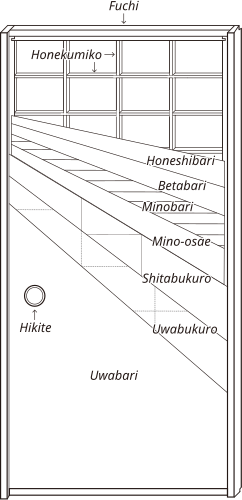
Names of fusuma parts
History of Fusuma
The kanji for "fusuma" is composed of the character "clothing" on the left side and the “deep” on the right.
The "fusu" in "fusuma" is said to come from the word "fusu (lie down)." It can be inferred that the word originally meant bedding used to keep out the cold in bedrooms, and eventually evolved into "fusuma shōji," an architectural component of Japanese spaces.
The "fusuma shōji" of the early Heian period (794-1192) were considered larger and heavier, and apparently having latches attached. In the middle and later periods of Heian, they began to be used as sliding partitions, and the decorations also changed from Chinese paintings to elegant Yamato-e paintings with waka poems pasted on them. In the Kamakura and Muromachi periods (1192(?)-1333, 1336-1573, respectively) the style changed to the Shuden-zukuri style, where small rooms were separated by sliding doors, and then to the Shoin-zukuri style, which placed greater importance on formality and ceremony. Gold leaf paintings of the fusuma doors, which symbolize power, and gorgeous, and luxurious wall paintings reached their peak during the Azuchi-Momoyama period (1573-1603), and were perfected by the Kano school and others in the Edo period (1603-1868).
Amid this, as opposed to the gorgeous splendor, the sukiya style was born from the spirit of tea ceremony, which placed importance on the concepts of "wabi-sabi," and the Fusuma designs became more natural and abstract. This trend increased the demand for "karakami shōji.” Karakami shōji is a type for fusuma featuring a finish with plain colored paper or paper with patterns printed on it using woodblock printing. Various patterns, such as the so-called Korin patterns of the Rinpa school, were created, harmonizing with rather casual sukiya-style architecture. Karakami literally means Chinese paper, but Japanese karakami, evolved from paper imported from China, achieved a unique development by creating particular Japanese patterns, and spread in its own way as top covering paper of fusuma that decorates Japanese living spaces.
Fusuma as Edo Hyōgu
Since the Heian period (794-1192), Kyoto had been the center of karakami production. However, following the Tokugawa shogunate's opening of Edo, karakami production also flourished there. Kyo karakami primarily used woodblock printing, applying mica and pigments to the blocks. In Edo, however, rapid population growth expanded demand, and repeated major fires destroyed woodblocks. Consequently, techniques like brush painting hakebiki and stencil printing katagami nassen were adopted for faster, larger-scale production. Combined with the distinctive “stylish” Edo sensibility, patterns evolved into free-spirited designs reflecting townspeople culture, incorporating familiar motifs. This development, known as “Edo karakami,” initially spread among the wealthy merchant class but gradually began to permeate the common people.
Woodblocks and shibugata (Ise-katagami) stencils for “Edo karakami” were handed down from the Edo period, but most of those precious tools were lost due to disasters like the Great Kanto Earthquake and the Tokyo air raids. However, thanks to dedicated artisans and townspeople, they were reproduced and firmly preserved today with new designs added. Also, “Edo honsarasa” gained popularity as fusuma paper. It refers to Japanese chintz fabric dyed using shibugata stencils, featuring floral, bird, and arabesque patterns applied with a round brush.
During the Meiji period (1868-1912), amidst the wave of Westernization, unique designs blending Japanese and Western styles were conceived. From the Taisho to Showa periods (1912-1926, 1926-1989, respectively), fusuma, which had served as works of art, began down the path of mass production and standardization, transforming into purely practical items.
The fusuma of Edo-hyōgu style possess characteristics and charm distinct from those of Kyoto, not only in the aforementioned karakami paper but also in the shape of the brushes, the application method of the base paper, the patterns of the top paper, and the simple yet stylish aesthetic that developed uniquely in Edo.
Hyōgushi artisans harmonize specialized techniques and materials to create a “functioning” fusuma.
Traditionally, fusuma components are crafted by various artisans: those who make the base frames, those who make the base paper, those who make the top paper, those who add decorations, those who make nails and other components, those who make handles, hinges, and other fittings, those who make and finish the outer wooden frames with lacquer, and those who make boiled paste (often hyōgushi themselves made the paste). Hyōgushi are those who harmonize these different specialized skills and materials and create functioning fusuma works. They honor the techniques passed down through generations, preserve and enhance their value by incorporating new designs and techniques to respond to today’s needs. Thus, they give a tangible form to the value and send it out into the world. This is the job of hyōgushi.
Fusuma that functions in Contemporary Spaces
In recent years, numerous new designs are available for fusuma paper, featuring modern colors and patterns, perfectly suited to contemporary spaces. With a wide selection of frame colors and materials, as well as handle shapes, fusuma sliding doors offer high flexibility, allowing you to customize them to your taste
Fusuma products also possess functional advantages that cannot be overlooked, such as moderate insulation and humidity-regulating effects suited to the climate of Edo/Tokyo.
Their beauty and comfort will undoubtedly be utilized in diverse ways also in future spaces.


References & Booklets
- Japanese and Housing, Vol. 3, SHIKIRI, Kōrin Publishing (In Japanese)
- Fusuma: A Study, Japan Interior Materials Cooperative Association (In Japanese)
- Fusuma, Ichitarō Mukai and Shūtarō Mukai (In Japanese)
- Tokyo Matsuya Saishōen (In Japanese)
Traditional Techniques or Methods
- For byōbu, gaku, fusuma, and tsuitate, the following techniques or methods shall be used:
- The base pasting shall be performed using the methods of "honeshibari (bone binding)," "betabari (full-coverage pasting)," "minobari (shifted layer pasting)," "mino’osae (shifted layer covering," "mawarisuki," and "fukurobari (bag-style pasting)."
- The byōbu hinges shall be attached using the "wing attachment" method
- The finishing pasting shall be performed using the "uwabari (top covering)" method.
(Source: The notification of designation as Traditional Crafts by the Ministry of Economy, Trade and Industry)
