Kansu
Handscroll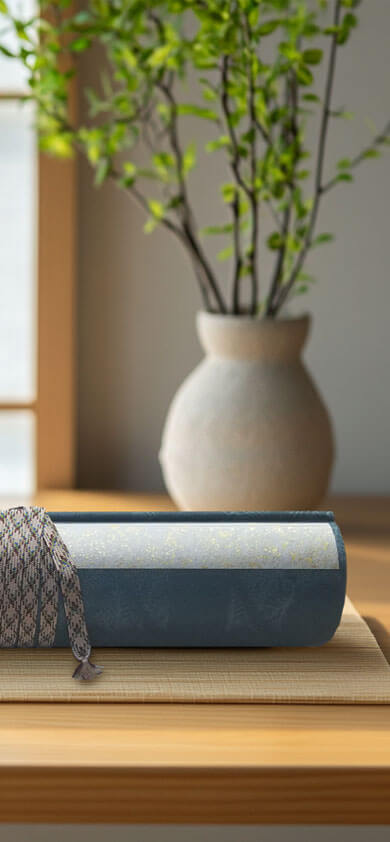

Kansu is characterized by its format, which allows viewing an extensive content at once by unfolding it with both hands. Consequently, it proved well-suited for Buddhist narrative paintings depicting sequential events, genealogical charts, and scriptures. The advantage of being rolled up for storage and preservation contributed to its widespread use.
To enable this repeated action of unfolding and rolling up, hyōgushi (mounting artisans) must achieve both durability and flexibility in the finished handscrolls.
Incidentally, we use the unit "kan" in Japanese to count multi-volume books as one kan, two kan, meaning volume 1, volume 2; this term "kan" originates from the Japanese word "kan" for kansu handscroll.
About Kansu Mounting
Sheets of paper are glued together horizontally, with a "hyōshitake (hyōmoku, cover bamboo)" attached at the front end and a "jikubō (axis rod)" at the rear end. The tip of the jikubō features an "inka (axis tip)." For storage, kansu is secured by winding it with the "makihimo (scroll cord)" attached to the cover bamboo rod. The areas surrounding the honshi artpiece are called the "gyokuchi," "inshu," and "okuzuke," and may be decorated with washi paper.
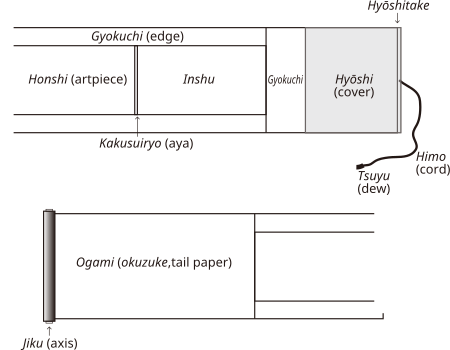
Traditional Techniques or Methods
- For kakejiku and kansu, the following techniques or methods shall be used:
- The "hada urauchi (skin backing)" shall be performed to back the artwork and textile, followed by "mashi urauchi (additional backing)."
- "Kiritsugi (cut and connect)" shall be performed around the honshi (artpiece).
- "Ageura (final backing)" shall be performed using a "uchibake" brush, followed by "urazuri (back rubbing)" after drying.
(Source: The notification of designation as Traditional Crafts by the Ministry of Economy, Trade and Industry)
