Kakejiku
Hanging Scroll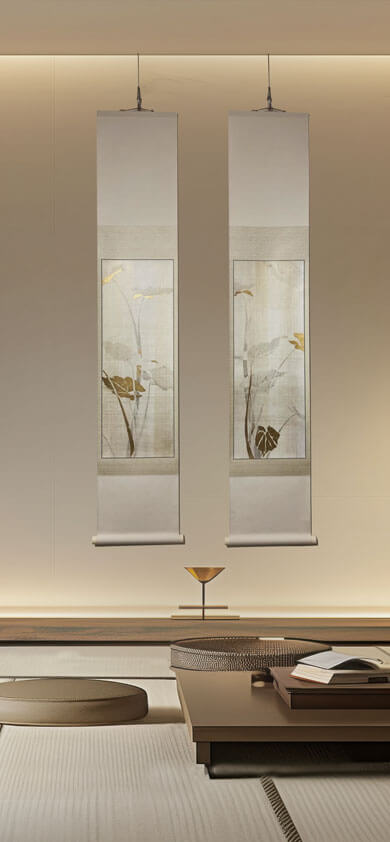
Designs of Kakejiku
Kakejiku was introduced from China alongside Buddhism. Originally, kakejiku works were lavishly decorated as objects of worship such as Buddhist paintings. However, as time passed, the mounting method came to be used for calligraphy and paintings other than Buddhist art. Today, simplified designs are common. The design formats include:
- Shin: Also called hyōhoe, the most formal design style for solemnly framing Buddhist objects of worship.
- Gyo: Also called dōhoe, a more casual style than Shin, used for mounting a wide range of works including divine names, calligraphy, landscape paintings, and flower-and-bird paintings.
- So: Also called rinhoe, the most informal format, often displayed in a small tea room primarily to mount a single-line Zen phrase.
These three main formats further subdivide into three types each.
Beyond these, there are also bunjin hyōgu (literati mounting), Mincho hyōgu (Ming-dynasty mounting), and sōsaku hyōgu which is entirely free-format creative mounting.
Method of Making Kakejiku
Traditional Edo-hyōgu products, designated traditional crafts, are made almost entirely by hand through every step by skilled artisans.
The materials used are specified as Japanese paper washi made from kōzo (paper mulberry) and other fibers. The pastes used are also required to be plant-derived wheat starch glue called shōfunori.
The basic method for making a kakejiku involves backing the honshi (artpiece) for reinforcement.
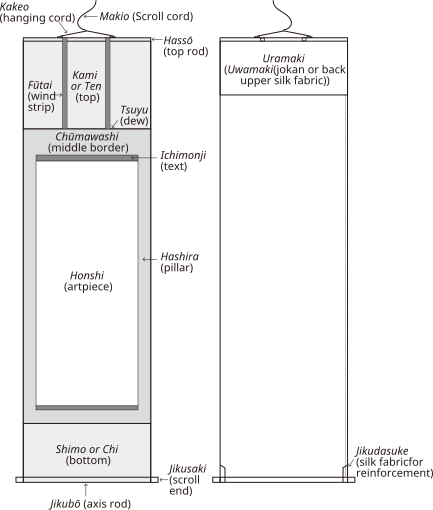
Kireji textile is backed to stabilize its shape and then sequentially attached decoratively around the edges (kiritsugi or cut-and-connect). The entire piece is backed (sōura or full backing, ageura or final backing), temporarily stretched over a frame for drying. After a specified time, it is removed and undergoes urazuri (back rubbing). Then, excess material is trimmed away, and the jikubo (mounting rod) —serving as both a weight when hung and support when rolled—is attached at the bottom, and the hassō bar at the top to which the hanging cord will be attached. If fūtai (wind strips) are present, they are also sewn on.
Commonly used sandan-hyōsō (three-part mounting)
Sandan-hyōsō is a mounting format where each section of kireji textile serves a distinct purpose while aiming for a harmonious and beautiful overall finish.
The narrow fabric strips at the top and bottom of the artpiece form an Ichimonji (single horizontal line), surrounded by the chūmawashi (middle) and hashira (pillar) borders." Above and below these are the tenchi (top and bottom borders), with fūtai strips added to the top section.
Living with kakejiku, an Edo-hyōgu item
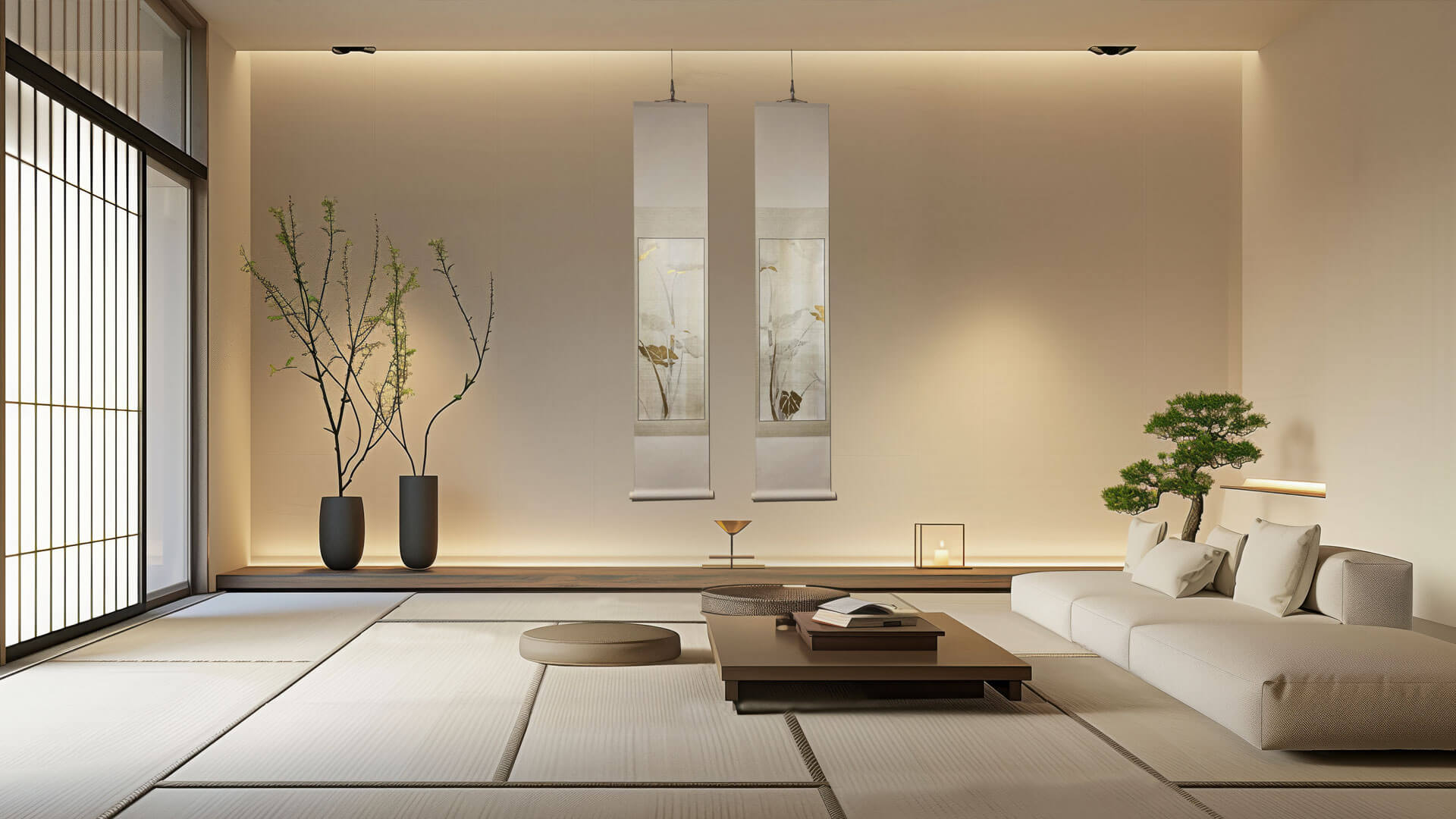
In recent years, changes in residential environments have led to the disappearance of tokonoma alcoves and Japanese-style rooms, gradually diminishing opportunities to appreciate hanging scrolls according to the seasons. Yet Japan once cherished a culture of displaying and admiring favorite kakejiku scrolls aligned with the four seasons and the twenty-four solar terms. Edo-hyōgu kakejiku products are not confined to traditional Japanese spaces like tokonoma alcoves or tatami rooms; some designs are suitable for hanging in Western-style rooms as well. We hope you will find the new charms of hanging scrolls as artworks you can display on various walls—and that they may contribute to integrating Japanese rich cultural heritage in your daily life.


Traditional Techniques or Methods
- For kakejiku and kansu, the following techniques or methods shall be used:
- The "hada urauchi (skin backing)" shall be performed to back the artwork and textile, followed by "mashi urauchi (additional backing)."
- "Kiritsugi (cut and connect)" shall be performed around the honshi (artpiece).
- "Ageura (final backing)" shall be performed using a "uchibake" brush, followed by "urazuri (back rubbing)" after drying.
(Source: The notification of designation as Traditional Crafts by the Ministry of Economy, Trade and Industry)
